
Stuck trying to figure out which business messaging platform to use?…
You are certainly not alone.
Deciding between Rich Communication Services (RCS) and WhatsApp Business is a common pain point marketing professionals are now faced with.
All online stores rely on these types of messaging platforms to connect with customers on a personal level.
And, marketing efforts, like traditional SMS, are no longer adequately meeting consumer demands, pushing eCommerce to explore more advanced options like WhatsApp Business and RCS.
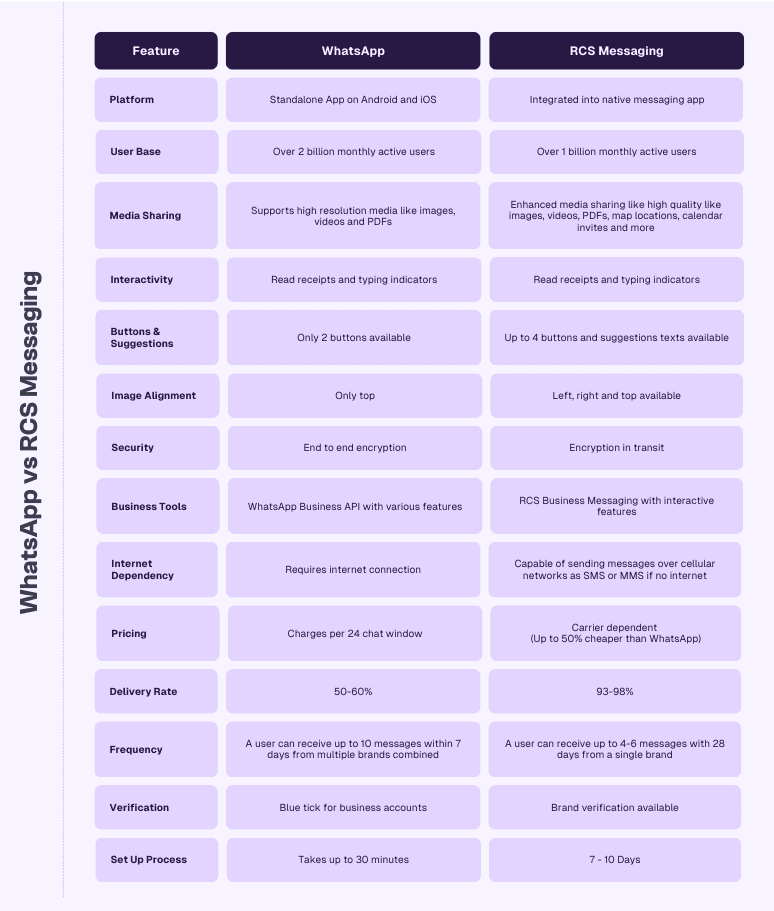
While both platforms offer modern messaging solutions, they have key differences that impact how businesses use them.
We’re not here to say choose this over this, we believe the benefits and features showcase themselves, and that will help you make the best decision for your business.
If you are new to RCS, here's a quick overview to get you up to speed.
RCS (Rich Communication Services) is an upgrade to traditional SMS, providing modern messaging features similar to platforms WhatsApp and WeChat.
With over 1.1 billion users in 2024, and Apple's adoption, the RCS usage rates have skyrocketed through the roof.
The big difference between platforms like WeChat are due to RCS operating within a phone’s default messaging app (think iMessage).
Which means that no additional downloads or app signups are required- but importantly, this does require the user's messaging app to be RCS enabled.
Key RCS Messaging Features
- High-resolution images, videos, and GIFs
- Typing indicators, read receipts, and real-time delivery status
- Verified business profiles for authenticity and trust
- Suggested replies and quick action buttons for faster interactions
- Rich card messages with images, descriptions, and links
- In-message payment options for direct transactions
- Group messaging with interactive features
- Location sharing for improved customer support
WhatsApp Business has become a prolific force in the world of eCommerce business messaging.
With over two billion users across the globe, it offers a familiar interface and a variety of tools to help businesses interact with customers and navigate commerce efficiently.
WhatsApp Business App is designed for small businesses, offering basic automation and messaging tools to manage customer interactions effectively.
WhatsApp Business API is built for medium to large enterprises, allowing integration with CRM systems, AI chatbots, and advanced automation for handling high volumes of messages.
Key WhatsApp Business Features
- Automated responses
- Rich media, like images, videos, and GIFs
- In-app interactive buttons
- Catalog and shopping integration
- Labels for customer organization
- WhatsApp Business API available for larger organizations
- Broadcast messaging capabilities
- Click-to-chat links
- Multi-device support
Customer Support
Businesses use both platforms to respond to inquiries, resolve complaints, and provide troubleshooting assistance in real time.
Marketing and Promotions
Companies send product updates, promotional offers, and announcements directly to customers to increase engagement.
eCommerce Transactions
Customers can browse products, ask questions, and complete purchases within the chat, making shopping more convenient.
Appointment Scheduling and Reminders
Businesses in healthcare, beauty, and professional services use messaging to confirm appointments and send reminders, reducing no-shows.
Order and Delivery Updates
Retailers and logistics companies send real-time shipping updates, estimated delivery times, and tracking details to keep customers informed.
RCS works within default messaging apps, so customers don’t need to install a separate app to receive notifications or branded interactions.
It also offers richer media capabilities compared to its predecessor, SMS, making it a strong alternative for businesses looking to reach customers who do not use WhatsApp and who want to veer away from Meta products.
Advantages
- Works on all major mobile operating systems.
- Secure with end-to-end encryption.
- AI-powered chatbots and automation tools.
- Established global user base.
Disadvantages
- Limited by WhatsApp’s messaging policies.
- Customers must have WhatsApp installed.
Advantages
- Works within default messaging apps, eliminating the need for downloads.
- Verified sender IDs reduce the risk of fraud.
- Supports multimedia, quick replies, and payment links.
- Now available on both Android and iOS, increasing its reach.
Disadvantages
- Currently still lacks end-to-end encryption.
- Carrier-dependent, making availability inconsistent.
WhatsApp Business Growth
- Continues to expand automation and AI-driven support tools.
- Increasing adoption for sales and customer service worldwide.
RCS Messaging Expansion
- Google and major carriers push for wider adoption.
- Apple’s adoption of RCS in late 2024 significantly expands its potential reach.
Well first and foremost, consumer trends shift quite drastically every quarter which means you need to keep up to date with what consumers want and how they prefer to interact with your specific brand.
We believe that these three factors will likely be the most prevalent trends to anticipate and watch out for.
- A Hybrid Approach
Many eCommerce stores will continue using both platforms, depending on their customer base and what they’ve become accustomed to in the past.
- Greater Automation
AI-powered responses will become the norm. AI is happening, it’s the future and nothing will slow down the adoption of automation, especially in enterprise level commerce brands.
- More Regulatory Oversight
Data privacy concerns will continue to reshape messaging policies and this is important to know, as RCS end-to-end encryption is inevitable.
Conclusion
WhatsApp Business and Rich Communication Services (RCS) offer unique advantages, and the right choice will always depend on your business goals.
If security, automation, and a global audience matter most, WhatsApp Business is the stronger option.
On the opposite end of the spectrum, if you prioritize native texting and rich media for local markets, RCS could be a better fit.
With Apple now supporting RCS, its reach has grown, making it a more viable option for businesses.
eCommerce brands looking for the best alternative to SMS marketing software should consider how both platforms fit into their long-term strategy.